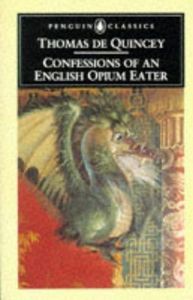
Thomas De Quincy's autobiographical tract Confessions of an English Opium-Eater is an account, you might have guessed, of the author's struggles and glories with opium. Though he was a brilliant and well educated young man, De Quincy - who had left school and was ashamed to ask for help - entered a period of near-homelessness in the dank London streets. This period of destitution resulted in chronic stomach pains, for which he began to take a tincture of opium, or Laudanum, to combat the pain. These Confessions are the result of a decades-long battle with addiction to the drug, divided into two parts: The Pleasures of Opium, and The Pains of Opium. De Quincy's Confessions earned him fame very quickly when it was released 1822. He was exceedingly well-read in the poetry and literature of the 17th and 18th centuries, which his lavish "impassioned prose" reflects. With virtuosity he describes his early years, from youth to maturity, and his early accounts of using the drug, which he did with restraint. The second part, which describes when he was taking enough opium to kill a donkey, details the fantastical and sometimes horrible visions he experienced while on the the substance. "The sense of space, and in the end, the sense of time, were both powerfully affected. Buildings, landscapes, etc. were exhibited in proportions so vast as the bodily eye is not fitted to conceive. Space swelled, and was amplified to an extent of unutterable infinity." His visions took on vast, Oriental themes, often correlated to Coleridge's Opium-induced poem "Kubla Khan." Since no one had studied the effects of drugs in much detail, De Quincey's account was held as the official reference for generations, often generating criticism that he focused too heavily on the "Pleasures." The "Pains" section however, with its visions of horror and grandeur, certainly could be read as a warning against the drug. That said, his work became a sort of instruction manual for experimentation, and may have lead several writers, including Francis Thompson, William Blair, and perhaps Branwell Brontë, to take the drug. Charles Baudelaire's 1860 translation would then spread the influence of the Confessions into the French-speaking realm.